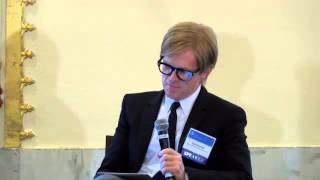
 >> So I'm going to introduce our next facilitator who will introduce the panel that's coming up next to talk about patient mediated exchange. I have a pleasure of introducing Lee Stevens I've known for many years. He's currently with the Office of Policy, interoperability policy efforts. But he's also the acting director of the certification program, he has worked extensively with our state work and our HIE efforts.
To promote exchange of health information. And has been involved in the space for a long time and working with states and the state governors association, working with our office even well before he was part of ONC. We're thrilled to have him as part of our ONC family, join me in welcoming Lee Stevens to the stage.[Applause]>> Lee Stevens: So I want to go ahead and invite the folks to come on up to the stage. We're going to show you a really incredible video from our PHR Ignite project down in Dallas.
When we were thinking about how to this goes way back. Ligea (ph) and I had we had a bunch of meetings and we were trying to think about where we can get a hospital to really give patients their data unencumbered, completely outside of all port always, patient owns it, exactly what division of consumer mediated exchanges, and we realize we realize we have to go somewhere where people can get really riled up. Because this isn't going to be so easy the first time. And so we went to Texas naturally.
And sticking with our Texas theme today, we're going to first show the sickle cell anemia patient mediated exchange video in children.(Video playing) >> When I found out she had sickle cell, I cried for I didn't want for my daughter. Some you don't want your child to go through any kind of pain.Children's Medical Center of Dallas is celebrating our 100th year, our submission to make life better for children. We care for children that are scattered throughout the state of Texas who have chronic illnesses. We saw a gap.
We saw our children being cared for in other areas without complete information. We wanted with our personal record project to be able to provide a solution, to have their clinical information available to them regardless of their location.>> The Office of the National Coordinator for many years has really been focused on enabling health information exchange across the country, and the technology is at a point now where really we have a moral obligation to harness that. And to make the lives better for patients. Sickle cell disease is a disease that impacts many organ systems throughout the body.
The benefit of having an accurate reflection of what's going on in terms of active problems and in terms of medications and in terms of recent health care encounters, that's really in valuable when you're going to be encountering people that don't necessarily know your story from birth in the way that we know their story from birth.>> Doctors up here are good, but they do not understand sickle cell. So with Etna, it's so much better. You know, I have documents and it's not hearsay. When I show them, they know that this is real.
And this is what's going on in her records. Right in front of them.>> The type of patients in this pilot program, they have chronic illness and it's something they'll have to deal with from birth to the rest of their life. Trying to manage that, trying to remember everything you've been on every medication, every treatment, any surgery, et cetera. Is really difficult to manage.
You know, you get stacks of paper from one doctor and then you get another stack from this doctor. How are you supposed to keep a that all together? What we've done is kind of given them one source. One location to keep that information all there. So immunizations, medications, even insurance information.
And if I'm something that's already kind of integrated itself into our lives. When we can give them those tools and a device so they can look at their children's medical records, they feel empowered, they can keep looking at their kid and smiling because they know there's one more thing they can do for their kid to make their life a little bit easier.>> This pilot at children's medical center, fundamentally changes the role of the patient. We believe this gives them the opportunity to own their data, to control it, to learn more about how they're doing, and to coordinate their care across all these providers. I think everybody understand the value here and they're excited about the path ahead.>> I really think children with the because it really does help.>> So we're really excited and very proud of the opportunity down at children's.
It took a lot of work to really get this data out of the EHR, to we had a great partnership with Microsoft, working with the children to help support this effort. And with Verizon donating phones that these parents could use. When we started thinking about empowerment and that's a word that comes up a lot, when we talk about consumer mediated exchange, this mother said a little bit more than what we showed in the film. She said when she takes her daughter to an emergency room in the middle of the night, and historically she has tried to tell the folks in the hospital what is going on with her daughter, what kind of treatment she might need.
That she felt like they thought she was stupid. That was a very that was a turning point for me. Because I realized right then and there that we're talking about a very different kind of empowerment than what I originally saw. This mother now feels much more safe and she feels a better trust relationship with her daughter's caregivers, in a clinical situation.
And I think the second thing we really learned from this pilot that was so powerful and really got me thinking about how, you know, a lot of people have thought that you needed an ivy league education to be able to use this kind of technology, that it was too complicated. That people might not really get it. This mother can use health vault as well as anybody in this country. There she grasps on how to use it right away.
There are no barriers to personal health records in this country right now. People can use them, all they need is an Internet connection. They can get their data anywhere, any time. And so this was a really breakthrough moment for us.
And with that, and what we're going to do now is I can get this is this on? We're going to talk to some folks who are making it happen in similar ways. Different places across the country. And this is to me, exciting panel to moderate because we can only talk about how awesome this is going to be for so long before we actually have to do it. And these folks up here, are actually doing it today.
So let me introduce Laura McCrery, executive director of the Kansas health information network. Mark Haney, the CEO and founder of get real health.Gilbert Salinas, a fellow with the institute for health care improvement. And Dr. Tim B, chief medical infomatics officer at OC HIN( phonetic) let's do down the road and have each of you talk about what your organizations are doing, and how you're engaging consumers.>> Thank you, Lee.
I'm Tim, with OCHIN (ph). It is a health centered information network based in Portland, Oregon. We run one instance of health record used primarily in the safety net clinics in 22 states, mostly community health centers, federally qualified health centers and rural health clinics. We have ruled outpatient portal, over the past couple years, starting to do open notes with that, as well as labs, immunizations, problem lists, and we're also starting to collect throughout patient portal some patient reported outcomes depression screening, social determinants of health, using both clinically and research projects through PACORI.>> Thank you very much.
Laura?>> Hi, I'm Laura McCrery and I want to thank you for inviting me to come from Kansas today to spend a couple of minutes talking to you. I run a health information exchange in Kansas, a statewide exchange, we connect currently 282 different organizations that are sending data using lots of different disparate EHR systems across lots of different health care organizations. We have just about 5 million patients that you can access through the exchange, and we provide sort of the standard health information exchange services including direct, which is secure clinical messaging, query based functionality so that you can search for patients across the R exchange and our surrounding states' exchanges. And then one of the things that we also do is we provide a free personal health record for all patients in Kansas who receive care in Kansas.
And so we started that last October. We rolled out the soft launch so we could kind of get the work out the bugs and we had 16 different organizations that agreed to be the pilot sites that ranged from individual physician practice up to a midsize hospital about a 200 bed hospital. So we have been work out all the bugs last year and one of the things we found is that if you can't provide the information directly to the patients about their health care, it's really a challenge. And so we have starting Phase II where we're going to bring all the information from the exchange, that we're gathering from 275 hospitals and physician practices and FQHC & community mental health centers and deliver directly to the patients so they get a notice real time that new information is available in their exchange, personal health record and it crosses all of the providers, not just one provider.
All the information is available in one place. So we're really excited about that. And I'll look forward to telling you more about it.>> Great. Mark?>> Mark: Thanks.
Good afternoon. My name is Mark Haney, I'm CEO and co founder of get real health. We make patient engagement platform that allows hospitals and other health care provider organizations to engage with patients around the house. That begins with giving them information but certainly not where it ends.
So basically, what happens is the patients can access their medical records, be via mobile device or with Web browser. They can also go ahead and communicate with the providers, get care information, get educational information. Get the information in a meaningful and understandable way. And basically, get a chance to understand their overall health picture.
Another thing we focus on is not just being the place where you get the information from just that doctor or just that hospital. But giving a place to get all your health information and collate together in a way you can understand. So we connect with Microsoft health vault and other data sources. We can bring in blue button data, direct data.
And we're always open and looking at new data sources, whether it Apple health kit or Google fit or whatever is coming down the road. Because health information comes in a lot of different forms and from a lot of different places.>> Thanks, Mark. And Gilbert?>> Thank you for being here. I have a dual role here so I'm going into my patient perspective and then I'll talk a bit about my professional career.
By way of introduction, I am what you would consider a very complicated patient. I have so many chronic things going on that there might be too much to list. But lucky for you I actually made a list. I'm going to read it to you.
So I have tendinitis, osteopenia, arthritis on my entire spine. Rotator cuff syndrome, partial paralysis, neurogenic bladder, chronic pain and degenerating lumbar. We know sitting is the new smoking. And all this is secondary to an accidental gunshot wound suffered at the age of 17 years old by one of my best friends.
As a kid. I actually grew up in a neighborhood and environment where it was safer to send your teen age kids to the military during the time of war than to keep them at home as teenagers.In my professional career, I'm actually a chief clinical officer for the same hospital where I did my rehabilitation and therapy after my injury. I now sit on executive leadership. We're transforming health care in many ways.
Electronic health records. But mostly with quality improvement and really enhancing how we provide care, pulling away from asking the question, what is the matter with you? To really what matters to you?>> Thank you. Laura, we're starting to see a lot of health information exchanges across the country really think about offering EHRs as a service. What made you decide to do that AKHEN, and what kind of benefits are you seeing?>> Well, you know, it's interesting, we begin creating a health information exchange in 2009, the Kansas Medical Society and the Kansas Hospital Association came together and what's there was really never a time we didn't plan on having a personal health record as a part of the services that we offered.
And as a matter of fact, as we started working with our state and building the capacity around health information exchange, it in fact is a requirement now in Kansas. If you're going to do health information exchange business in Kansas, you must offer a free personal health record to any patient that receives care in Kansas.So it was never really a question of if we were going to do it. It was more a question of how we were going to do it. And providing a personal health record utilizing a health information exchange is pretty complicated, and I.
Think we may be one of the farthest along, but we really learned a lot of lessons as we've gone through this, and one of the things that is really significantly challenging is patient matching, across all of the different providers that are sending data to a health information exchange, because you can't deliver the wrong information to the patient. So you have to be very, very cognizant of what's happening around patient matching issues.>> That's really interesting. We talked a lot about regulatory and policy weavers about how to make exchange works and it sounds like Kansas has really tapped into a powerful one with PHRs there.Mark, really, in thinking about PHR, and EHR developers, how do they best support patients getting access to their health information?>> There's a number of things that developers can do to help patients get access to their information. But getting access to their information is really just the beginning of the process.
In order to make it easier, one is deliver things on mobile devices. Not everybody has a PC, and I think we're seeing as time goes by, more and more people are living their entire digital life on their phone. So it's absolutely essential that you don't build an experience that's really only going to work for them to have a PC.Once you give people their information, you have to think about how you give them that information. Many of us have a physical personal medical record at home, basically a file folder with a bunch of stuff from your doctor.
An electronic copy of that isn't much better, fits's basically one piece of paper from every time you visited a doctor with whatever information happened to come up during that visit.You need to take that data and create a longitudinal record and go ahead and show it in ways that an are meaningful to people and they can do useful things with and begin to understand, you need to give them context and explanation and education. You need to give them a way to talk about that information, use it to start a conversation with their provider.You know, not too many people wake up in the morning and say hey I want to look at my medical records but there are plenty people who wake up in the morning thinking, you know, I want to be healthier, I want I. Wish what can I do to help 'my elderly mother manage her condition better? You know, all the things people want to do are really verbs, they're actions, they're not just consuming data. So you need to keep that in mind.And the other thing that developers need to really do is embrace things like blue button and like direct.
That allow those people to take that data and take it to the application of their choice.Because no one application is going to fit everybody perfectly all the time. And so giving people access to their information but not making it easy for them to take that information, and using it in a way they want and the application they want, isn't really serving them the way that we want to.[Applause]>> Thank you very much. You know, making sure that the data is usable, is so important. I'm a semi care giver for my father and when I call him he's in North Carolina, did you get the results of that blood best back? His response you is wouldn't believe how nice this doctor is.
And he goes on and on. He called me on Friday night, do you know how few doctors would call me on Friday what are the results of your blood test? Oh, I'm fine.Has no idea. But the doctor is nice and called him on a Friday night. So you know, having that information available is incredibly useful if a prescription needs to get filled.Gilbert.
How have you been using technology to communicate with your providers?>> I'll take you to through one of my experiences I had last year. I was selected as a Kaiser safety net fellow for institute of health care improvement. They choose one fellow a year that works in a public hospital, a chance of a lifetime, right? Only problem was that my health care providers would be 3,000 miles away from me. Of and they 'doesn't have any physical location that was anywhere near the greater Boston or Cambridge.
If I want to go to Harvard and I wanted to do this fellowship with IHI, I would have to make the choice. I had 3 choices. I could go with the different provider. I could go a year without health care.
Or I could learn to redesign my own care. And flip it. What we did is redesigned my health care. Along semi providers, I.
Had just learned to grow and love them, and working with them for over 15 years, I really trust them. And so what we did is we sat down and we looked at all the ways I needed my care delivered. We looked at my durable medical equipment needs. Keep in mind I see many different doctors.
For my ailments. Last year I had about 8 average clinic one year, that's average. And with the year with IHI, I only had 3. So we redesigned the entire way I.
Received my care, everything was done on line, and through phone calls, communication. Scrips were written up and delivered in time to get my medication from California to Cambridge. And what are the results? I look back to 2008, and charted all of my information. We took baseline measures on my liver and kidney functions and pain.
I've never been healthier, since 2008. With only 3 clinic visits. And since I've been back, I've continued this process. Once again chasing the saving money.
And enhancing my quality of life and better health and much better experience.>> Fantastic. Thank you.Tim, why is it important for providers like you to be able to receive health information from your patients?>> So on the opposite side from Gilbert's story, many patients. And they would all like to get their care, many of them would in the same way gig Bert has described. Decreasing the number of face to face visits.
Many of them in rural area have a difficult time getting into clinic. And if we can increase the electronic communications, we can increase the access, and number of patients, make it easier for them to get in to see their care, and frankly, as a provider in a busy clinic, it's much more efficient for them to take care of business that way. One of the difficulties with our current payment system, it doesn't allow for that. I think we have an area there with payment reform where we need to focus on the ability to provide care in that manner.
In a much more patient centric way, assuming they get financially feasible.>> That's very helpful for those of us in ONC to think about. So thank you very much.>> And one last piece, too. When data are coming in, electronic value, discrete data, patient reported outcomes, pain data, et cetera, we can use clinical decision support tools both wan clinic provider facing, also have clinic decision support tools patient facing outlying their outlining prescriptions that haven't been picked up, those type of things.>> That's that really reminds me of a trip that we took down to MD Anderson where they had been doing patient mediated exchange for almost 10 years. And one of the things that they told us is it's so helpful for both the provider and for the patient to have an electronic log of exactly what has been said back and forth.So you know, no matter how many times you tell someone verbally something, or how many times you give it them written down on a sheet of paper that.
Information may not be remembered the right way. Might spill your coffee on the paper. A million things can happen. And having an electronic copy of it can be very helpful on both sides.Laura, you're working on a pilot to help veterans communicate with non VA providers using the K N portal.
Can you tell us more about this?>> Sure. You know, Kansas is a pretty big state. 85,000 Square miles. And we have 3 very large military bases in Kansas.
And we have about 250,000 veterans that live in Kansas. And those veterans get care at the VA facilities and then they also get care at non VA. Facilities. And so about a year ago, the Veterans' Administration, the Robert J.
Dole building approached us and said we really want to see if we can work out a way where our veterans can take the summary of care data they're receiving through the blue button initiative and send that to their non VA providers and we think the way we can do it that is using the KHEN, my Kansas Healthy record is what our patient portal is called and would like to be able to work with you to send that information via direct message together Kansas providers that are non VA facility providers. So we got a group of folks together, very fun opportunity. We work with Hutchison regional medical center, a midsize hospital for our state, about 250 beds. And we used the KHEN, my Kansas healthy record, and we used veterans, my healthy vet, and together we were able to teach veterans in Hutchison Kansas to be able to download their blue button with using the blue button to their My Healthy Vet, personal health record, and then they would save that matter summary of care document and upload into the my Kansas healthy record.
And then they would send that via a direct message to Hutchison regional. And then Hutchison regional, they used a Siemens EHR system, able to save into the nursing notes there at Hutchison regional so the nurse has access to the information at the time the veteran came from the VA facility.So that sounds like it's kind of a convoluted process and did take a little while to work through all of the challenges associated with the work flow. But we really had pretty great success, and were able to get the information from the VA facility to the non VA facility using personal health records and the patients were able to learn how to do it, the veterans were able to learn how to do it. They learned to do it themselves and I think it was a really successful project for us to show how not only can we provide the information to the patients, but then how can they really take ownership to make sure it gets to the facilities where they were going to get non VA care at.
We were excited about it.>> That's, you know, it makes me think about in Kansas, and in Oklahoma, I know that a lot of places in this country, think about tornadoes. And last year when the tornado hit Moore, Oklahoma, the more regional hospital was completely wiped out. One of the really amazing things about the transfers that happened out of that hospital is that through health information exchange, every single patient had their data available when they arrived at multiple different hospitals in the area around Oklahoma City.And for Kansans, this is also a huge benefit. If their home is ever destroyed.
If it ever hits urban area. That this data would be accessible anywhere that they can get an Internet connection.>> You know, to make a comment about that. Our exchange has been fairly successful. We haven't struggled as much with the interoperability problems other places have.
But one of the things we get from all of our hospitals is what's called an ADT admit discharge and transfer. So we know immediately when a patient has been registered at a hospital. So one of the things that happened is that we realized that we could use the exchange to find patients. In an emergency.
Because before patients may be taken to multiple hospitals all over the region, well now the exchange knows that the patient has been registered at the hospital and by searching in the exchange for the patient we can finds which hospital they've been taken to in the event of a emergency. So I think about that like the situation in Boston where patients were taken to all different locations. And they couldn't find them. Well, now, with health information exchanges, ADT feeds coming in, we can find the patients immediately.>> Yeah, it's a big deal.
And it's often overlooked. Emergency preparedness and response. And how we support people, you never realize how much you need it until it's too late. And the good news with consumer mediated exchange ask that we're getting there a lot faster.
We'll have this backup.Gilbert, what would make it easier for patients to send their information to providers?>> You know, Lee, I think the biggest myth that we have is that people living in underserved communities, lower social economic will not use technology if they're given the technology. In my experience, you know, I feel we need the technology and later we'll be talking about expanding broadband coverage in rural areas. This is America, I'm sure we have satellites that can track a squirrel in Machu Picchu. I think I feel that if you give patients what they need, the tools, they'll make the right decisions and keep themselves healthy.
I've never mental health met a patient that didn't want to be healthy. I think about other industries and think about what uber has done for transportation. What do they do? Give their drivers iPhones. Why can't we give our patients iPhones?>> That's exactly right.
And 'again, it just goes that empowerment piece. Some of the folks, there's always been the skepticism there would be use and understanding of what this is. And we have found it to be completely the opposite. There's a very high degree of technological savvy out there in the world.>> I'd like to add to that, too, the video is a great example of humanizing the experience.>> Yeah.>> And making sure that we're always connecting those dots with patients.
And helping them realize why it's so important to watch their kids and grandkids grow up. Always bringing back the human aspect of this. It's been very important. >> Mark, what are the biggest challenges facing EHR, and PHR developers related to patient mediated exchange?>> I think there's a couple specific things that are posing present and looming challenges for patient mediated exchange.
The first one is very tactical and really a technology that has to do with trust bundles and I. Won't get into too much of the bits and bites of it. Because not everybody is a developer and I don't want to put anyone to sleep. But really use of blue button trust bundle, use trust bundles that are dedicated to patient connections.
The providers need to get away from thinking they can use direct trust and call the job done.You know, sharing data with patients is not an afterthought. That seems to be a little bit of the attitude of some of the players.The other thing, and this is going to take a lot more work because this isn't just a simple technical issue. How do you bring that data into the clinical work flow? I mean, patients are going say we can get patients to be able to easily and quickly get their health data they want. Whether it from other providers, labs, their pharmacy.
Home health care workers. Behavioral health information. Social services information. Information from Google.
Fit. Apple health kit. Of what you. How do you get that in the hands of care providers in a way that they can work it into their work flow? It's not really something they're prepared for.So you can't just dump it all into the electronic medical records and not distinguish it.
Because then it's just this massive data where you can't tell the difference between what's happening in your hospital or the you know, your direct care to this patient. Versus information that has been forwarded along a couple of times.So really the system has to get better at adjusting the better, parsing the data. But most importantly, they have to get better presenting the data in ways that are useful, very specific parts of the clinical work flow. You know, what data is going to be for an ED.
Doctor, is not the same data that's important to a primary care physician or rheumatologist or oncologist. So it's going to take a real partnership with the health care providers to figure out, the data is coming. You know, all the work is being be done. Patients are going to have this data, and they're going to want you to have access to it and want you to consider in your decision making, how do we help you consume and use that data usefully?>> Absolutely.
That's a really important point. It's you know, when we started recognizing that the data is actually moving, you do all of a sudden need to know, well, who put this data in? Which part of it came from which provider? And those are important parts. And those are all pieces that I think we're really starting to look at to get a little bit more constrained in our thinking about some of those distinct elements about how we identify where the data is coming from and when.Tim, you guys originally have low participation, and what did you do to change that?>> When I started my most recent move and started practicing at a new clinic, we had about 30% of our patients had signed up for our patient portal. And we didn't really have a particular plan in clinic for how we were going to increase that.
And didn't frankly, wasn't a priority to increase that number. There were a couple of us in Clinton that I can realized the potential for patient port always, the patient benefit as well as for our clinic efficiencies. And we took it on as as an improvement project and chartered it and went through a formal process for that. What we started off doing even before we started that process, though, was to have a meeting of the leadership.
We had our lead physician, our chief nursing person, represented from the appropriate from the front desk staff, financial and executive director. And we got a small group of people together and we agreed this was going to be a priority. And I've seen this play out over and over again at other clinics. Until you get that group of people on board and all committed to this improvement project, it's not going to happen.
Once we get that group in place, then we had an all staff meeting. We went through some of the myths, there's a lot of misunderstanding, particularly among physicians, about what patient port always are and aren't. There are a lot of concerns and anxiety around front office staff, they're going to get swamped by phone calls about medical records, and something that's wrong on the problem list, et cetera. And really the research, some of which we heard about earlier, borne out over and over again, that it doesn't change that much in the office work flows, if anything it increases efficiency slightly.
And so we went through some of those myths and answered questions and then went into a training program. Unfortunately, even the best EHRs right now don't have great graphic user interface. Which buttons do you click to release a lab result with a patient, how do you send a message about the CBC result? So there's a certain amount of training that needs to go along with that. Until the office staff is using that patient portal tool over and over again on a regular basis, it just doesn't become familiar.
So you have to kind of push through that initial process to the point where they're using it on a regular basis.And then we went through several PDSA cycles where first we had the rooming staff trying to get the patients to sign up for patient portal, enter the access code. Got a little bit of a bump, up to about 40% with that. And we started giving out access codes at the front desk for other patients and got up another 5 or 10% of our patients with that.And then we realized that really it wasn't going to be any one group of people in the clinic that the providers were going to have to be talking up with the patients because they had a great relationship with the patients. Rooming staff needs to take a couple of extra minute at the beginning of the visit with a new patient to get them signed up in the exam room.
Front office desk had to talk it up. A team play. As we heard earlier from Mark, the work flows. We needed to redesign some of the work flows for lab result releases, could send a message through a portal faster than a letter but the staff weren't familiar with doing the letters.' So we had to redesign the work flows and able to get up now 50 or 55% much patients are on with a patient portal.
And working recently with mow loan MOLINA health care. And they had an interesting situation. Brought about half clinics up without patient portal and got used to work flows without it and brought a couple 40 or 50% of the patients using it. And then they brought a couple other clinics up and from day 1 with those clinics, when they went live with EHR, they had the patient portal built into every single work flow and hit about 90% participation.>> Wow.[Applause] >> I think now we're going to try something a little different with some questions from Twitter.
We're actually going to of course I. Got comfortable we ran right on and taking up a lot of time. But anyway, thank you all very much. This was a great opportunity.[Applause]>> Is this on?Okay, great.
Thank you so much, the panel for not helping us see how access to blue button data is actually being used and practiced, to support patients and patient care. And in a really important way. My two favorite quotes from the session are. Shifting the discussion from what's the matter with you to what matters to you.
And sharing information with patients should not be a afterthought. Those are my two quotes I will be requoting, so thank you for that..

No comments:
Post a Comment